Climate Action
 |
Reducing greenhouse gas emissions across our value chain
Our changing climate is impacting the health of people and reducing crop yields, leading to greater food insecurity. Many diverse and underserved communities are disproportionally impacted by climate change and now face higher barriers to health and access to nutritious foods. And these same communities are most at risk for undernutrition, hidden hunger and obesity.
As a global food company, we can play a role in helping to lessen the impact of climate change and create a climate-positive future.
Our Commitment
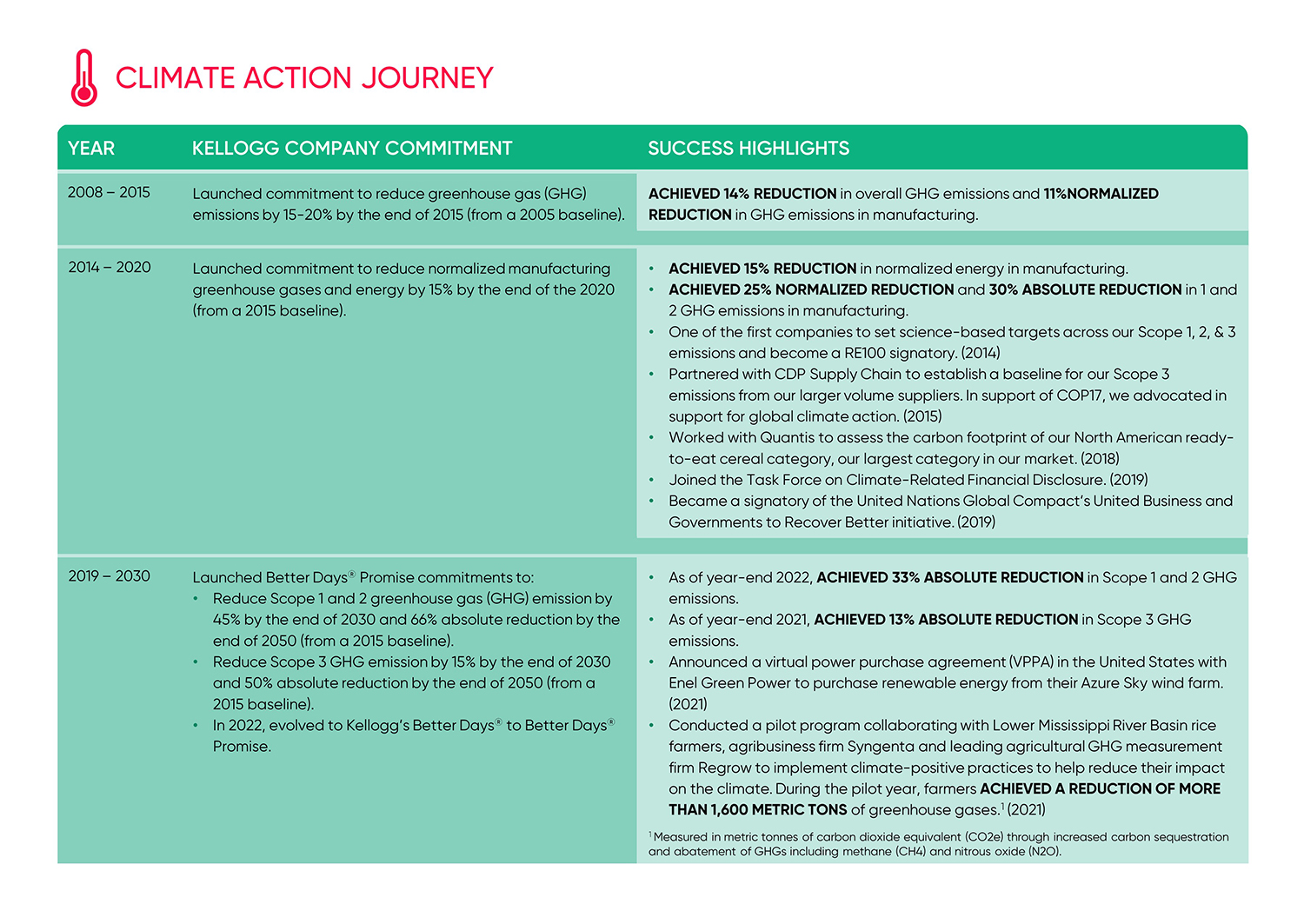
As part of our Kellanova Better Days™ Promise goal to create better days for 4 billion people by the end of 2030, we aim to reduce greenhouse gas (GHG) emission across our value chain.
In 2015, Kellogg Company was one of the first companies to set science-based targets. Today, Kellanova is committed to setting company-wide emission reductions in line with science-based net-zero standards with the Science Based Targets initiative (SBTi).
The Science Based Targets initiative is a global body enabling businesses to set ambitious emissions targets in line with the latest climate science. In 2023, Kellanova undertook a robust due diligence process in partnership an independent consultant that delivered a decarbonization modelling tool, a high-level net-zero roadmap and critical dependencies for success.
Our Approach
As a business, we are committed to responsible corporate citizenship and a thoughtful science-based approach to climate solutions, regularly sharing lessons learned and identifying new ideas at consortiums, trainings and other events.
We believe transparency and advocacy will help drive this change to protect our planet. That's why we joined the Task Force on Climate-Related Financial Disclosures. We are leveraging our global scale and voice to drive climate action and nature-based solutions for climate change issues across our supply chain.
When looking for a risk-based solution to help reduce GHG emissions, we consider the holistic landscape throughout the value chain and the latest climate science. We urge others to join us on the journey. Our approach addresses:
-
Manufacturing – Drive absolute reductions through behavior change, operations, renewable energy, procurement and CapEx investments.
-
Supply Chain – Engage our larger suppliers to measure and report Scope 3 GHG emissions and work with our suppliers based on volume and emissions to drive climate action.
-
Ingredients and Packaging – Build climate risk and resiliency into our ingredient materiality process and prioritize GHG reductions for our key ingredient and packaging supply chains.
-
Transparency and Advocacy – Drive systemic change through engagement and advocacy with industry and governments, annual disclosure in financial and non-financial reporting, and sharing lessons learned.
Greenhouse gas (GHG) emissions are measured and aligned to the guidance outlined in the Greenhouse Gas Protocol and are verified by a third party annually. For more information, please visit our Kellanova Better Days™ Promise Commitments and Methodology.
Kellanova is a new company with a foundation that’s more than a century long. We are committed to carrying forth the legacy of Kellogg Company, who led with purpose to create a positive impact for people and planet. Like our name signals, we’re building on that legacy of doing good, built over the previous 117 years, while looking ambitiously toward the future.
Progress reported below is for Kellogg Company through the end of 2022. Kellanova will report on progress toward our commitments in our initial Social and Environmental Report that we will issue in 2025.